Site Meter
Showing posts with label Riverton. Show all posts

Thursday, January 26, 2017

Crowd funding for the environment centre


The lovely building that houses the Riverton Environment Centre has come up for sale. We've been in there for 15 years, making us the longest continuously-running environment centre in New Zealand, and paying rent for all of that time. Now, we have the opportunity, wonderful opportunity, to buy it. Being a not-for-profit organization, working with volunteers with hearts of gold, we are going out to the public to ask for help, through a page on the Pledge Me site: We launched the page today and already have donations from a number of kind people but we've a way to go before we get the $75,000 we need to make the building our own. It's exciting for all of us, especially when a new pledge comes in, so if you want to make our little eyes shine and our hearts flitter-flutter, you know what to do and if you do, I thank you, very much!
Robert


Saturday, January 7, 2017

The Essential Forest Gardener

If you care to read the 12 chapters of my soon to be published on paper, book, "The Essential Forest Gardener", the link is here.
Weka, who authors posts on The Standard blog, put the chapters up for me, week after week for 12 weeks, then compiled them into one place and that's where my link will take you. I've also linked, here, to Ad's post on the same blog, where he (or she, I don't know Ad's gender) sums up after the series finished. It's a lovely follow up to the 12 posts and I'm grateful for the mention. The work is not quite as polished as it needs to be before being printed out in the form of a hold in hand book, but Antoinette, part of the Happen Films crew that filmed "An Invitation for Wildness" in our garden and home recently (here's the link to that film - 102,917 views so far!), is professionally proof-reading it for me and pruning off the extraneous bits to make it more readable. Exciting times!

Tuesday, December 27, 2016

The yurt has landed!

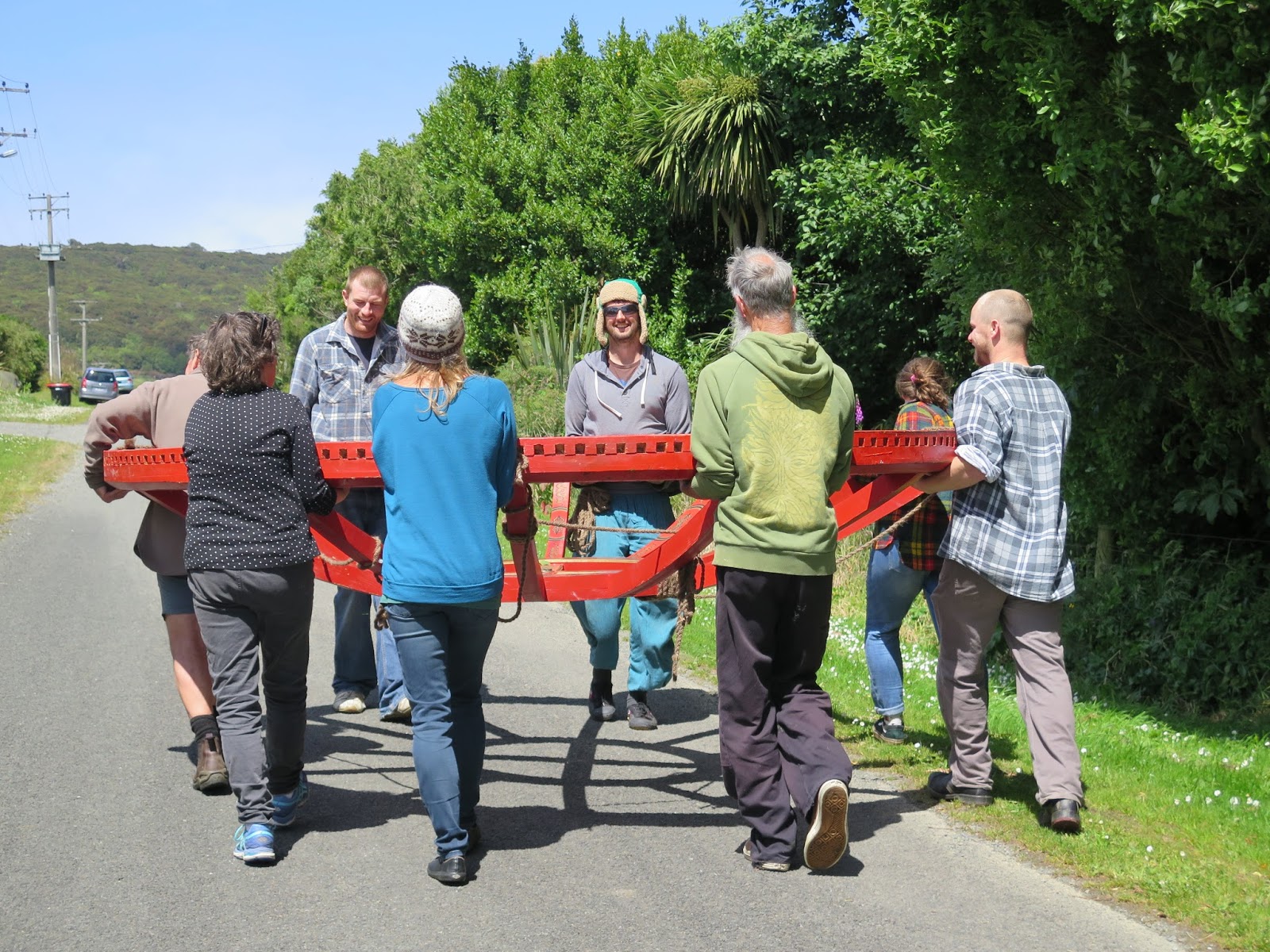
The truck arrived early (Well done, Richmond Transport). Unfortunately, so did the wind, which blew its lungs out all day and made handling the parts of the yurt extra challenging. Friends turned up to help unload and store away the rolls of thick felt, the curved trellising, the painted spokes, the huge "wheel" that forms the centre of the roof and the covers; traditional and waterproof/modern. The greatest challenge, as you'll see from the photos, was lifting down the "wheel" from the roof of the truck, where it had been strapped for the journey down from Nelson. We roped it up and eased it down after having moved the truck to a sheltered place out of the wind. There were plenty of us holding onto ropes and giving advice and once we had the heavy thing on the ground, it just a matter of carrying it up the hill and into our forest garden, where once reassembled, the big yurt will serve as a meeting place for our community and a venue for music, dance, meeting and whatever else any of us can imagine. It's a very exciting prospect and while there's work ahead, putting it all back together, there is a community here willing that to happen. Here follow some of the photos taken during the day.


Sunday, May 15, 2016

We're up on Youtube

Our most recent production, "Forest Garden - Autumn" is online now and if you'd like to take an 8-minute look at what our garden was like last month, make yourself a cup of tea, click on this link and (I hope) enjoy.


Tuesday, April 26, 2016

Forest garden

Wilson's Early plum

Japanese Raisin 

Sunday, November 29, 2015

Climate Change event - Riverton

We didn't march, chant or wave placards but instead occupied the viewing platform overlooking the estuary where we set up signs and banners, listened to a presentation on Wise Response, talked about local evidence of the over-charged climate and enjoyed the sunshine and sparkling waters that fell upon our shoulders and surrounded us, respectively. A preacher from the Anglican church, the Reverend Denis Bartley, led the discussion and was supported in the way that kaikorero traditionally are, with a waiata from members of the church's choir. Gulls wheeled, cars slowed to read the banners, life went on as usual in our tiny coastal village. Here's a pic of Denis at his outdoor pulpit. Thanks to all who turned out this Sunday to make a statement about Climate Change.


Friday, September 11, 2015

Island of the birds


I spent last night on Stewart Island. I was woken this morning before 6 by kaka calls. The flights over and back were a treat; beautiful weather effects framing the island and calm air to soothe the most nervous flyer. I sat beside the pilot and tried to keep my feet off the dual controls. Successfully. I had dinner at the South Sea Hotel last night and lunch today here in Riverton. Leo's at home with me, sleeping on the couch, his "big boy's bed". We've already fed the hens and walked "through the forest". Riki and his friends are visiting this afternoon for a wander through the same forest and tonight we're having dinner with Jelle and Doetie.

Tuesday, August 4, 2015

Saturday, February 28, 2015

Giant Willow Aphid

A curious mixed swarm of honey bees, wasps, bumble bees and flies feeding from something on the grass beneath a basket willow tree in a garden in Riverton alerted me to the presence of masses of huge grey aphids cloaking the stems of several of the willow's branches, and I knew immediately that the Giant Willow Aphid Tuberolachnus salignus had arrived in the Deep South. I'd been hoping it wouldn't get here, but it has and for a willow-grower like me, this is very bad news. This aphid is far bigger than those we are accustomed to and, while it only feeds on willows, causes great harm to anyone relying upon willows for any purpose, from basket-making to shelter belts. I've collected a jar-full to take to the regional council for their records and intend to douse the remaining aphids in detergent, the only solution I've read of that is effective without being lethal to other creatures. Here's what they look like. They're not pretty and neither is the result of their occupation.


Monday, February 9, 2015

Beyondsemble in Riverton

I'm organizing a performance by these exuberant people for this coming Friday evening, here in Riverton. More to come on that soon...


Beyondsemble

"A pyrotechnic display of dazzling virtuosity by four highly imaginative and gifted musician."
"These four talented musicians have the skills to make music of the highest quality look easy.
They play together with complete trust...This concert was exhilarating and seemingly faultless"
With responses like this, it is no surprise the band has shot into the limelight on the local festival scene and is getting a lot of attention offshore.
An eclectic and diverse mix of tunes and songs both original and sourced from around the globe are executed with virtuosic skill, infectious energy, a sense of adventure and an exuberance of spirit.

Thursday, January 15, 2015

Food forests growing in popularity - today's Southland Times

Food forests growing in popularity
DAVE NICOLL

It's almost like having the produce section of a supermarket in your backyard... only it's not quite as organised.

Food forests, also known as forest gardening, are an easy to maintain and sustainable way of cultivating a garden by creating a mini ecosystem in your backyard.

One of the world's leading examples is growing in Southland.

Permaculturalists Robert and Robyn Guyton had been working on their Riverton forest garden, which has been internationally recognised, for over 20 years.

It was in the last three years that the couple have been running workshops teaching people how to develop their own food forests.

"We've probably spent about 30 hours working on our garden since spring," Robyn told the group.

Anytime we need anything we just go for a browse, Robyn Guton said.

"All year round I can have a green salad."

The couple even had their own bees and hens.

However, they still had to buy dairy products and other essentials, she said.

Yesterday the Guytons hosted a group of ten people at their property who had come from throughout the South Island to see their forest.

Juliet Pope said she had come from Arrowtown with her family to see the Guyton's "legendary" food forest.

"It's the best example, evidently, in the world of a cool climate food forest."

Pope had done a permaculture design course and was also a qualified architect, she said.

Pope and her husband had two and a half acres on which they had fruit and nut trees, plus ducks and chickens, she said.

"We're going to continue working with the orchard and bring in more diversity."

They were trying to make their property to be self-reliant and grow a lot of their own produce, pope said.

"It's about resilience."

One of the challenges was letting go of neatness and control, and the idea of a conventional garden and just allowing nature to take over, she said.

John Borger who had come with his wife Valarie said he was there to learn something new.

The couple owned a 12 acre hazelnut orchard in Thornbury.

The retired dairy farmer said he liked the idea of food forests because you didn't have to do a lot of work, and that weeds were actually not a problem.

They had a traditional vegie garden which required a lot of weeding but they were looking at incorporating some elements of a food forest into a section of their orchard, he said.

"We'll try and see what works and what doesn't."

Julia Middleton-Chapman took part in one of the Guyon's workshops two years ago and since then they have their own food forest and are looking to expand.

"We've taken ideas from our tour of the Guyton's food forest from two years ago and basically tried to emulate what they are doing there."

Their food forest ,which is located at Riverton where they live, is unique in that it features a a bike track running through it.

"One day we might be able to pick apples as we're biking past."

Initially she said they put in regular gardening work as they started from a dirt patch, she said.

"Although in saying that it's not a regular garden so you're not having mow lawns or maintain it in that regard, you're more often that not planting more plants."

"We had to build up the soil and just try and create a better sort of soil for everything to grow in."

In the future they were hoping to be able to grow produce to sell at the Environment Centre in Riverton, she said.

Steps to starting your own food garden:

Do a stocktake on what you have got and don't clear-fell your property because you might lose your shelter

Find out where the sunny, windy, wet and dry spots are on your property to know which plants to put where - Blackcurrants like the shade, where as grapes will want some sun.

Then think of what plants you like and check if your neighbours have them because you can grab cuttings or seeds.

Finally just thicken things up - as you add plants you can remove things you don't want and mulch them up.

- The Southland Times
Join hundreds of thousands who found relief with this new formula!


It's almost like having the produce section of a supermarket in your backyard... only it's not quite as organised.

Food forests, also known as forest gardening, are an easy to maintain and sustainable way of cultivating a garden by creating a mini ecosystem in your backyard.

One of the world's leading examples is growing in Southland.

Permaculturalists Robert and Robyn Guyton had been working on their Riverton forest garden, which has been internationally recognised, for over 20 years.

It was in the last three years that the couple have been running workshops teaching people how to develop their own food forests.

"We've probably spent about 30 hours working on our garden since spring," Robyn told the group.

Anytime we need anything we just go for a browse, Robyn Guton said.

"All year round I can have a green salad."

The couple even had their own bees and hens.

However, they still had to buy dairy products and other essentials, she said.

Yesterday the Guytons hosted a group of ten people at their property who had come from throughout the South Island to see their forest.

Juliet Pope said she had come from Arrowtown with her family to see the Guyton's "legendary" food forest.

"It's the best example, evidently, in the world of a cool climate food forest."

Pope had done a permaculture design course and was also a qualified architect, she said.

Pope and her husband had two and a half acres on which they had fruit and nut trees, plus ducks and chickens, she said.

"We're going to continue working with the orchard and bring in more diversity."

They were trying to make their property to be self-reliant and grow a lot of their own produce, pope said.

"It's about resilience."

One of the challenges was letting go of neatness and control, and the idea of a conventional garden and just allowing nature to take over, she said.

John Borger who had come with his wife Valarie said he was there to learn something new.

The couple owned a 12 acre hazelnut orchard in Thornbury.

The retired dairy farmer said he liked the idea of food forests because you didn't have to do a lot of work, and that weeds were actually not a problem.

They had a traditional vegie garden which required a lot of weeding but they were looking at incorporating some elements of a food forest into a section of their orchard, he said.

"We'll try and see what works and what doesn't."

Julia Middleton-Chapman took part in one of the Guyon's workshops two years ago and since then they have their own food forest and are looking to expand.


"We've taken ideas from our tour of the Guyton's food forest from two years ago and basically tried to emulate what they are doing there."

Their food forest ,which is located at Riverton where they live, is unique in that it features a a bike track running through it.

"One day we might be able to pick apples as we're biking past."

Initially she said they put in regular gardening work as they started from a dirt patch, she said.

"Although in saying that it's not a regular garden so you're not having mow lawns or maintain it in that regard, you're more often that not planting more plants."

"We had to build up the soil and just try and create a better sort of soil for everything to grow in."

In the future they were hoping to be able to grow produce to sell at the Environment Centre in Riverton, she said.

Steps to starting your own food garden:

Do a stocktake on what you have got and don't clear-fell your property because you might lose your shelter

Find out where the sunny, windy, wet and dry spots are on your property to know which plants to put where - Blackcurrants like the shade, where as grapes will want some sun.

Then think of what plants you like and check if your neighbours have them because you can grab cuttings or seeds.

Finally just thicken things up - as you add plants you can remove things you don't want and mulch them up.

- The Southland Times

Tuesday, January 14, 2014

Movement Unleashed - Te Araroa


Max Bell wrote:

Hey Robert.

I'm working with two guys who stayed with you recently on their way walking across New Zealand. I'm running the internet-side of spreading their project, as they're raising money for charity as part of it. We've put up a blog post here - http://movementunleashed.com/trapped-by-flooding-the-walk-update-2/.
We've posted a link to your blog. I'm wanting to ask if you'd be keen to share a link back about their walk project, so we can get the word out more and raise more money for charity.


Jack and Rowan stayed with us overnight at a very early stage of their big walk and I'm more than happy to post on their project and progress. While they were here, Jack banged out some tunes on our ancient piano while Rowan and I wandered around the garden, identifying the sorts of plants the two of them might find and eat as they make their way north. Now that they are days further on from here, I'm really feeling for them, as the weather has been scabby-as. This link shows where they are at now and the kinds of challenges they are facing. It's just as well that they are so well prepared physically. Walking through the wilderness in this weather can't be easy! 

Monday, January 6, 2014

17, 919 & 7,008 - both growing apace


These two youtube 'food forest' clips are continuing to attract attention (and good comments) but the question is, who's the down-thumber?

Sunday, April 21, 2013

Global recognition for little old Riverton


I've just now been sent the link to the work of Craig Mackintosh, Permaculture Research Institute of Australia editor, featuring our forest garden. Craig visited us a month ago, interviewed and photographed Robyn and I talking about our projects and filmed me on a walkabout tour of the forest. I'm very happy with the results and feel it represents well what we are doing here in our wee town. If you have a few minutes to spare, I invite you to click on the link to the PRI website and enjoy a wander around our garden.

Monday, December 31, 2012

The Carbon Capture Report (keeping tabs)

This profile page summarizes all known activity of the location Riverton, New Zealand (General), New Zealand related to Coal. This location may have appeared in articles supporting this topic, against it, or in a separate context: this biographical entry simply demarks this location as appearing in content suggesting contextual association with Coal. 

If you comment on coal through media of any sort, you appear on the "Carbon Capture Report", with gradings of all sorts. Here's Riverton's page, on which my modest blogging makes a wee splash. There are pretty graphics too. It's possible that this post will be added to the statistics kept by the compilers of the Carbon Capture Report, thus changing the graphic I've chosen, which may change my ratings one way or the other.

Tuesday, June 12, 2012

Fairtrade editorial - Southland Times


Riverton is a canny choice to become, maybe, the first Fairtrade town in New Zealand.

Towns and cities with this designation – and there are more than 1000 of them in 20 countries – have shown collective, practical support for the goals of the movement supporting producer organisations to deliver sustainable livelihoods for farmers, workers and their communities.

Aparima College pupil Hollie Guyton has set up a committee to bring Fairtrade status to her school and town.
Riverton is an excellent introductory town for this to happen in Southland; it's a compact community with pretty good Green credentials due, at least in some part, to the influence of Hollie's parents, Robert and Robyn Guyton: Green activists in the political sense – he is an Environment Southland councillor – and the practical, as witnessed by the splendid South Coast Environment Centre Open Orchard project to revive fruit growing in Southland.

As things stand none of New Zealand's small towns has the Fairtrade endorsement. But that's not because it's some loopy scheme.

The fact that Dunedin, Wellington and Auckland do have this status should reassure those who might otherwise assume it entails a collective ban on all products that haven't received the big green benediction.Not so.

The towns simply have to meet goals including a sufficient range of Fairtrade products being available; demonstrable support from a local council resolution and participation from the likes of schools, workplaces, places of worship and community organisations; a steering group, and – well, they can tick this one off – media coverage.

Fairtrade has been gaining traction throughout the country, sales last year rising 24 per cent to $45 million.

For the most part that's been coffee and chocolate, although bananas, tea, sugar and cotton clothing also figure. And the range of products is ever-broadening. Auckland Grammar, don't you know, has switched to Fairtrade certified sports balls, made by workers paid an acceptable minimum wage, rather than being handstitched by impoverished Pakistani children.

Fairtrade consumables are supplied from farmers receiving fair and stable prices aimed to cover the cost of sustainable production as well as a premium to be invested in social, environmental and economic projects in their own developing communities. (A few New Zealand farmers might, in their darker moments, wonder whether they qualify ... ).

Mutterings against Fairtrade tend to be that it puts the consumer in a position of choosing between a locally made product and one from a developing nation, with all those wicked extra food kilometres and carbon footprints. But the products are not commonly grown or produced locally and – as New Zealand often has to point out to its own trading partners – air miles aren't the only determinants of virtue.

So, for instance, compare and contrast the options of cotton from African farmers on the brink of starvation or from subsidised United States farmers.

Will Riverton embrace the scheme? It might do. The town surely seems a logical starting point, and one which could then give other communities a local basis for comparison.

Ms Guyton's group aspires to convince other areas in Southland, and Invercargill city, to take part. Seems reasonable.

- © Fairfax NZ News

Monday, June 11, 2012

Miss Guyton does good


(Reproduced verbatim from today's Southland Times)

An Aparima College student is setting out to make Riverton the first Fairtrade Town in New Zealand, a goal which is impressing national organisers.
College student Hollie Guyton, 17, said it was a goal that could easily be achieved by year end. She had set up a meeting with the Southland District Council and hoped it could help. Riverton was a community with many farmers, who agreed it was important to help farmers overseas get paid a fair price, she said.
She set up a committee to transform her school and Riverton into Fairtrade places. The committee of about 17 students took their cause into the wider Riverton community, who have embraced the idea.
"We have been campaigning around the town and businesses have been receptive," Miss Guyton said.
Five businesses were on board and the committee aimed to turn all workplaces to Riverton Fairtrade before the end of the year.
To be Fairtrade certified businesses would have to promote Fairtrade and use its products.
Aparima College Fairtrade committee member Jacob Brown said he explained to businesses that Fairtrade helped everyone involved with the products.
"The worker and farmer in developing countries get paid real wages and can feed their families and lift their lives out of poverty," he said. Miss Guyton and her committee now plan to convince other areas in Southland to take part.
They also plan to work with Invercargill schools to achieve Fairtrade City status for the city. Fairtrade New Zealand marketing and communications officer Angus Coull said New Zealand had three Fairtrade cities: Dunedin, Wellington and Auckland but no small towns as yet.
"Riverton is doing an awesome job for its small size. It really stands out because it has achieved a lot and I commend the school pupils for implementing and recommending Fairtrade," he said.
If Riverton achieved town status, it would be the most southern Fairtrade Town in the world.


COLLETTE DEVLIN


- © Fairfax NZ News

Monday, June 4, 2012

Grim news

For several years now, we've been told, quite correctly in my view, that the amount of Co2 we can safely allow in our atmosphere before we start to see a rise in global temperatures, is 350 parts per million. At the various events that were held over that time to draw attention to the importance of recognising the danger of exceeding that figure, the level could be seen to be rising. Three years ago, Southlanders gathered at Oreti beach to build sand castles below the high tide mark to illustrate the danger to low lying communities on the islands, deltas and basins of the world. At that point we were told that we were in the 390's for global Co2 levels. The following year, when Rivertonians gathered on the viewing platform to create an umbrella forest to highlight the unstable weather we are to expect with rising atmospheric temperatures, and got blown practically inside out by the squalls that thrashed us on the day, the level was even higher. Today I learned that global gas levels have passed to 400ppm mark. This is not cause for celebration at all. I've always felt there would come a time when we would all need to batten down the hatches and this latest news supports my fears. Worse still, international efforts to reduce greenhouse gas emissions have failed entirely, so far as I can see. Targets are not being reached or even stiven-for. The new approach to climate change, climate instability, global warming seems to be; prepare yourselves for difficult times ahead. If you live near the coast, think of relocating. Tough luck if you are a low lying island community. Tough luck if you live in an arid region. Or if you are an ice-dweller. All will presently change. Gloomy news I know, but that's how I'm seeing it. What to do? Seems it's every man for himself. Woman and children too, plus every other manifestation of humanity that you can think of. It doesn't seem cheerful news to me. But there it is, we've topped the 400 mark. Congratulations, humanity. You're almost there!

Tuesday, May 8, 2012

What's happening in Riverton?


Plenty, that's what and here's just one helping of that. This young woman has introduced the town to Fair Trade and has enlisted enough support among the shop owners and other organisations around the village to make us the first New Zealand town to go 'Fair Trade' en masse, drinking Fair Trade teas and coffees on our breaks and otherwise promoting the activities and philosophies of the Fair Trade movement. Impressive, that young woman - great vision and superb genes.

Wednesday, May 2, 2012

Turner

This morning's sun pushed it's way through fog as it rose over the estuary at Riverton.